Is This Pet Food a Complete Diet? Read the Label
Learn how to tell whether canned food, kibble, pouches, toppers, and treats provide a complete diet or only complementary nutrition.

Is This Pet Food a Complete Diet? Read the Label
A can can look like a meal. A bag of kibble can look nutritionally dependable. A pouch may say “real chicken,” “natural,” or “premium.” None of those clues tells you whether the product can safely provide the whole diet.
Many everyday kibbles are formulated as complete diets, but not every dry product is complete. Some canned and pouched foods are complete too, while others are toppers, complementary foods, treats, or products intended only for occasional feeding. The processing format—wet or dry—does not decide nutritional adequacy.
The most useful question on any pet-food package is:
Does the label say this product is complete for my pet's species and life stage?
If the answer is unclear, do not use the product as the whole diet until the manufacturer or your veterinarian confirms it.
“Complete” describes nutrition, not texture
Pet food comes in many forms:
- canned food;
- trays and pouches;
- kibble;
- baked or air-dried pieces;
- freeze-dried products;
- refrigerated or frozen food;
- toppers, broths, and mixers; and
- treats and chews.
Any of these forms could be complete or incomplete depending on how it is formulated and labeled. Moisture changes texture, storage, calorie density, and the numbers shown in the guaranteed analysis, but moisture does not determine whether all essential nutrients are present in the correct amounts and ratios.
The FDA explains that “complete and balanced” means a product is intended to meet a pet's nutritional needs when fed as the sole diet according to its directions. In the United States, that claim is generally substantiated through an AAFCO nutrient profile or an AAFCO feeding trial.
On labels using European or similar international terminology, look for complete pet food. The European Pet Food Industry Federation explains that wet food may be either complete or complementary and that the label should identify which one it is.
Canned food is not automatically incomplete
It is easy to encounter cans that contain only tuna, chicken, broth, or another simple recipe. These products may look like a full meal but lack enough vitamins, minerals, fatty acids, amino acids, calcium, or other essential nutrients for long-term feeding.
That does not mean canned food as a category is incomplete. Many canned cat and dog foods are specifically formulated and labeled as complete diets. Others are not.
Use this distinction:
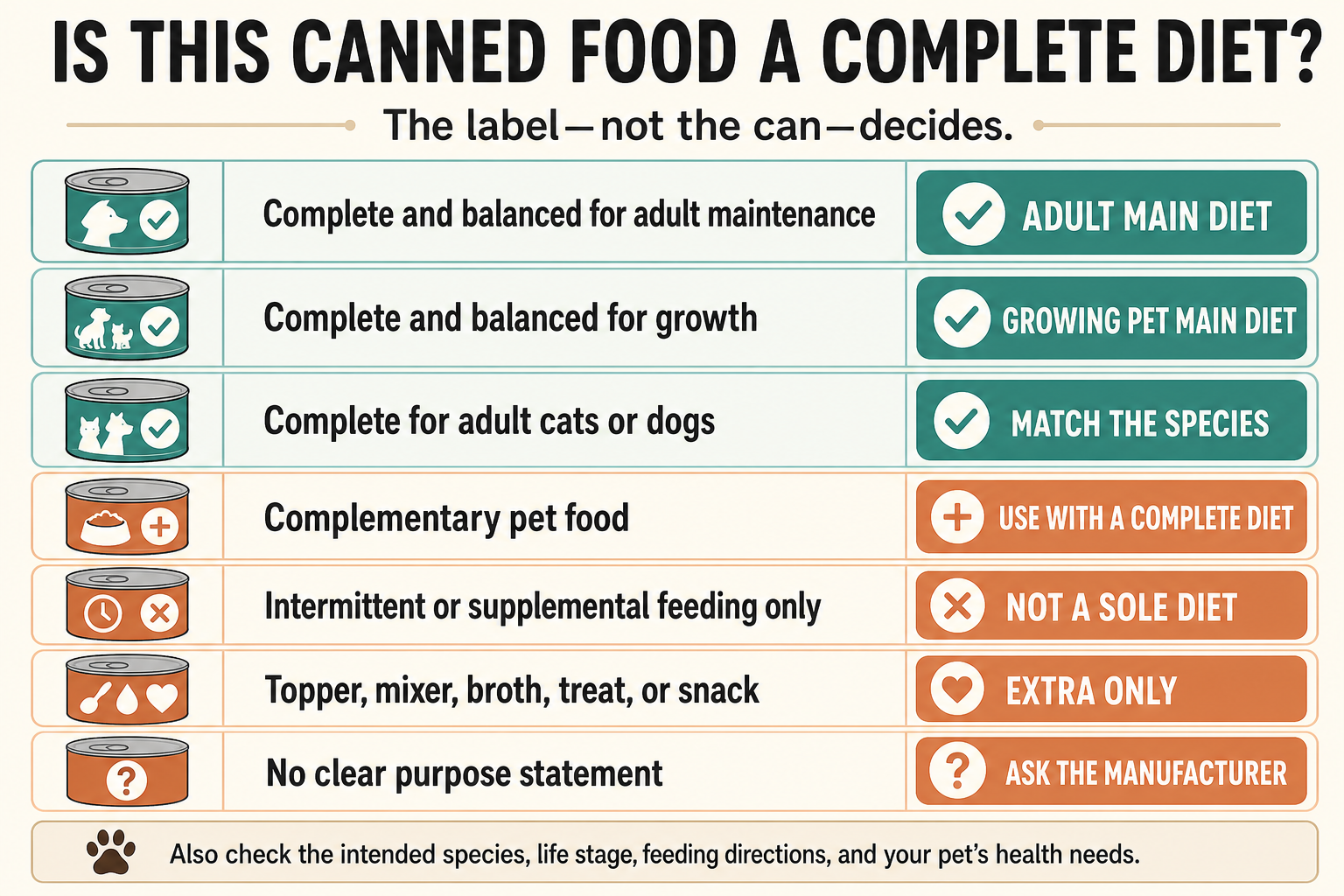
The label—not the can—determines whether a product can serve as the main diet.
Do not judge by appearance. A pâté containing added vitamins and minerals may be complete. A beautiful can of whole fish fillets may be nutritionally incomplete.
Kibble is often complete—but still check
Many bags marketed as daily cat or dog food are complete and balanced. Kibble is convenient for delivering a consistent formula, and complete dry diets are widely available.
But a dry texture is not a guarantee. These products may also come in bags:
- training treats;
- dental treats and chews;
- meal mixers;
- dehydrated ingredients that require a balancing product;
- supplements;
- single-ingredient meat pieces; and
- foods intended only for intermittent or supplemental feeding.
A dry product labeled “dog food” or “cat food” may be complete; a dry product labeled “treat,” “topper,” or “mixer” often is not. Find the purpose or adequacy statement every time, including when changing flavors within the same brand. Product lines can contain both complete diets and complementary products in very similar packaging.
Where to find the important statement
The decisive text is often on the back or side of the package in smaller print. It may appear near the ingredient list, guaranteed analysis, analytical constituents, feeding guide, or manufacturer details.
Look for headings or phrases such as:
- Nutritional adequacy statement
- Intended use
- Complete and balanced
- Complete pet food
- Formulated to meet
- Animal feeding tests
- Adult maintenance
- Growth
- All life stages
- Complementary pet food
- Intermittent or supplemental feeding only
The AAFCO label-reading guide describes the nutritional adequacy statement as one of the most important parts of the package. It should identify whether the product is complete and balanced and, when applicable, for which life stage.
Do not stop after finding the word “complete” in marketing copy. Read the formal statement and make sure it refers to the actual product, species, and life stage.
Common complete-and-balanced wording
An AAFCO-style label may use wording similar to:
- the product is formulated to meet the nutritional levels established by the AAFCO Dog Food Nutrient Profiles for a named life stage; or
- animal feeding tests using AAFCO procedures substantiate that the product provides complete and balanced nutrition for a named life stage.
The important information is not whether formulation or feeding tests were used in isolation. Confirm all three parts:
- It says complete and balanced or uses a recognized adequacy statement.
- It names the correct species—cat or dog.
- It names an appropriate life stage.
On FEDIAF-style or other international labels, the front or back may say complete pet food for adult cats, complete pet food for puppies, or similar wording. “Complete” is the key category; “complementary” has a different meaning.
What “complementary” means
A complementary food contributes nutrients, flavor, moisture, or variety but is not designed to provide the whole daily nutrient balance by itself.
Examples can include:
- meat or fish in broth;
- meal toppers;
- lickable purées;
- biscuits and treats;
- certain soups or drinks for pets;
- vitamin or mineral products;
- foods designed to be combined with another specific product; and
- some therapeutic products used under veterinary direction.
Complementary does not mean poor quality or unsafe. It describes the product's intended nutritional role. A complementary topper can be useful when given as directed alongside a complete diet. It becomes a problem when it displaces too much complete food or is mistakenly served as every meal.
Read the feeding directions carefully. Some complementary products are meant to be added in a precise ratio to another food. Others are occasional extras. Do not invent a balancing combination from two incomplete products.
What “intermittent or supplemental feeding only” means
On many AAFCO-style labels, this phrase means the product is not substantiated as a complete and balanced continuous diet.
Use it as:
- a topper;
- a treat;
- an occasional addition;
- part of a professionally formulated combination; or
- a veterinary-directed product for a particular purpose.
Do not use it as the sole long-term food simply because your pet likes it. Appetite and nutritional completeness are different questions.
Some veterinary therapeutic products may carry supplemental wording because their nutrient levels are deliberately modified for a medical purpose. Follow the veterinarian's directions rather than applying ordinary treat rules to a prescribed product.
Match the correct species
A complete dog food is not a complete cat food. A complete cat food is not necessarily an appropriate daily dog food.
Cats require a feline-specific balance that includes reliable taurine, preformed vitamin A, arachidonic acid, and other nutrients. Dog food should not become a cat's regular diet, even when both foods are meat-based.
Check the words, not only the animal photograph. The intended species should be stated on the label. Products labeled for both cats and dogs are often treats or toppers; if one claims to be a complete diet for both, read the adequacy wording especially carefully and ask the manufacturer how the requirements of each species are met.
Match the life stage
Completeness is not universal. A food can be complete for one life stage but unsuitable as the main diet for another.
Common life-stage descriptions include:
- growth for puppies or kittens;
- gestation/lactation for pregnancy and nursing;
- adult maintenance;
- all life stages; and
- region-specific descriptions for particular ages or sizes.
A food for adult maintenance may not support a growing puppy or kitten. A growth or all-life-stages food may provide more energy or certain nutrients than a sedentary adult needs. Large-breed puppies have particular growth considerations, so confirm that the product is appropriate for their expected adult size.
“Senior” on the front does not by itself describe a universally regulated life-stage nutrient profile in every market. Look for the formal adequacy statement and discuss individual medical needs with a veterinarian.
Feeding directions are another useful clue
Complete diets normally provide directions for how much to feed based on the pet's weight and life stage. AAFCO notes that foods labeled complete and balanced require feeding directions.
However, a feeding table is not proof by itself. Complementary products may also suggest daily portions. Always connect the directions to the adequacy or purpose statement.
Use the printed amount as a starting estimate rather than a guaranteed prescription. Calorie needs vary with body condition, age, neuter status, activity, health, environment, and the number of treats or toppers fed.
Ingredient lists cannot prove completeness
An ingredient list tells you what was included, in descending order by weight at formulation. It does not show whether the final recipe supplies every essential nutrient in the right amount and ratio.
These descriptions do not prove completeness:
- real meat;
- single protein;
- grain-free;
- natural;
- premium;
- holistic;
- human-grade;
- high protein;
- ancestral; or
- veterinarian formulated.
A product containing only chicken is not automatically a balanced chicken diet. Muscle meat is high in phosphorus and low in calcium and does not supply a complete nutrient profile by itself. A longer ingredient list containing carefully selected vitamins and minerals may be nutritionally more complete than a short, visually appealing recipe.
Read the adequacy statement before debating individual ingredients.
The guaranteed analysis cannot prove it either
The guaranteed analysis or analytical constituents show selected nutrient values, commonly protein, fat, fiber, moisture, and sometimes ash or additional nutrients.
These numbers are useful, but they do not list every essential nutrient. A product can show high protein and still be incomplete. “Complete and balanced” depends on the entire nutrient profile, not one impressive percentage.
Wet and dry numbers also should not be compared directly without accounting for water. The FDA notes that canned food commonly contains far more moisture than kibble. A canned food may show a lower as-fed protein percentage while containing substantial protein after moisture is removed from the comparison.
Do not conclude that kibble is more nutritious simply because its printed protein number is higher.
Beware of the topper takeover
A pet may begin with a complete base diet and gradually receive more broth, canned meat, freeze-dried pieces, treats, table food, supplements, and powders. Eventually, the complete food becomes a small part of the bowl.
This can:
- dilute essential nutrients;
- unbalance calcium and phosphorus;
- add excessive calories;
- create vitamin or mineral excesses;
- make the pet refuse unadorned food; or
- interfere with a prescription or elimination diet.
Keep complementary extras modest. Ask your veterinarian how much room exists in the calorie and nutrient plan, particularly for kittens, puppies, small pets, animals with medical conditions, and pets eating therapeutic diets.
A 30-second package check
Before buying a main food, answer:
- Species: Does the label clearly say cat or dog?
- Purpose: Does it say complete and balanced or complete—not complementary or supplemental?
- Life stage: Does the named stage fit this pet?
- Directions: Are daily feeding instructions provided?
- Calories: Can you find calories per can, pouch, cup, or kilogram?
- Company: Is there clear manufacturer or distributor contact information?
If the purpose statement is missing or hard to interpret, photograph the label and contact the manufacturer. Ask directly:
“Is this product intended to be the sole daily diet for my pet's species and life stage, and what nutritional standard supports that claim?”
A clear answer is more useful than assumptions based on packaging.
Combining canned food and kibble
You can combine wet and dry food when both products are appropriate for the pet and the total calories are measured correctly.
If both are complete for the correct species and life stage, the combination can remain nutritionally sound when portions are adjusted. If the canned food is complementary, treat it as an extra and keep the complete food as the nutritional foundation unless a veterinarian or the manufacturer's precise directions provide a balancing plan.
Do not feed the full recommended daily amount of kibble plus the full recommended daily amount of canned food. That commonly doubles up calories. Calculate a portion of each or ask the veterinary team to help.
When to ask a veterinarian
Seek individualized nutrition advice when the pet:
- is a puppy or kitten;
- is pregnant or nursing;
- has kidney, urinary, liver, heart, pancreatic, gastrointestinal, endocrine, or allergic disease;
- is underweight or overweight;
- has unexplained appetite or weight changes;
- eats a home-prepared diet;
- refuses most complete foods; or
- needs several complementary products to eat.
Do not add vitamin or mineral supplements to a complete diet without a specific reason. More is not automatically safer, and some nutrients can cause harm in excess.
The practical takeaway
Kibble is often sold as a complete daily diet, but not every dry product is complete. Canned food may be complete or complementary. The package format does not answer the question.
Find the formal adequacy or purpose statement. Look for complete and balanced or complete pet food for the correct species and life stage. Treat complementary, topper, treat, and intermittent or supplemental feeding only as signs that the product should not be the sole continuous diet unless a veterinarian directs otherwise.
Start with purpose, species, and life stage. Then consider calories, feeding directions, ingredients, moisture, and individual health needs.
For broader guidance, read How to Read Pet Food Labels Without Getting Lost, Pet Food Label Claims Explained, and Cat vs. Dog Diets: Why Cats Need Taurine.
FAQ
Are most canned foods incomplete?
No reliable rule says canned food is generally incomplete. Many canned foods are complete diets, while many simple meat cans, broths, toppers, and pouches are complementary. Check each label.
Is kibble always a complete diet?
No. Many everyday kibbles are complete and balanced, but dry treats, mixers, supplements, and some specialty products are not. Confirm the formal statement on that exact product.
Can I feed complementary canned food with kibble?
Usually it can be used as a modest topper when it suits the pet, but it should not displace too much complete food. Follow the label and account for the added calories. Ask your veterinarian when the pet has a medical condition or restricted diet.
What if the label does not say complete or complementary?
Do not assume the product is suitable as the whole diet. Contact the manufacturer and ask whether it is intended as the sole daily food for your pet's species and life stage and how nutritional adequacy was substantiated.
This article is for general education and is not a substitute for veterinary nutrition advice. Consult your veterinarian before changing the diet of a growing pet or an animal with a medical condition.
Common questions
Is canned pet food a complete diet?
Some canned foods are complete diets and others are complementary foods or toppers. Check for a complete-and-balanced nutritional adequacy statement or the word complete for the correct species and life stage.
Is kibble usually complete and balanced?
Many kibbles sold as daily dog or cat food are complete and balanced, but dry treats, mixers, supplements, and some specialty products are not. Always confirm the label rather than relying on the food's form.
What does complementary pet food mean?
Complementary food does not provide the full daily nutrient balance by itself. It must be combined with an appropriate complete diet or used as directed by a veterinarian or the manufacturer.
