Can Cats and Dogs Share the Same Food?
Learn when cats and dogs can share freeze-dried, air-dried, canned, and single-ingredient foods—and what to check before serving.

Can Cats and Dogs Share the Same Food?
Cats and dogs are very good at making each other's bowls look interesting. In a mixed-pet home, it is tempting to buy one pouch, can, or bag for both—especially when the front shows plain chicken, beef, or fish.
Some products can be shared as occasional extras. Single-ingredient freeze-dried or air-dried treats are often the simplest candidates because there are fewer ingredients to assess. Canned wet food is usually less suitable for sharing because most cans are formulated as complete food for one species. But neither rule is absolute. The label, not the processing method, should make the decision.
The short version is:
- A complete cat or dog food should normally go only to the species named on the label.
- A treat, topper, or food for intermittent feeding may sometimes be shared if it is labeled for both cats and dogs.
- Cats generally do better with smaller, easy-to-chew pieces.
- A shareable extra is not a replacement for either pet's complete and balanced diet.
Start with the intended species
Look for the words for cats, for dogs, or for cats and dogs. Do not rely on an animal picture, the flavor name, or the ingredient list alone.
The AAFCO guide to reading pet-food labels explains that the intended species should appear on the main display panel. It also identifies the nutritional adequacy statement as the key place to learn what type of pet and life stage a food suits.
Use these label-first rules:
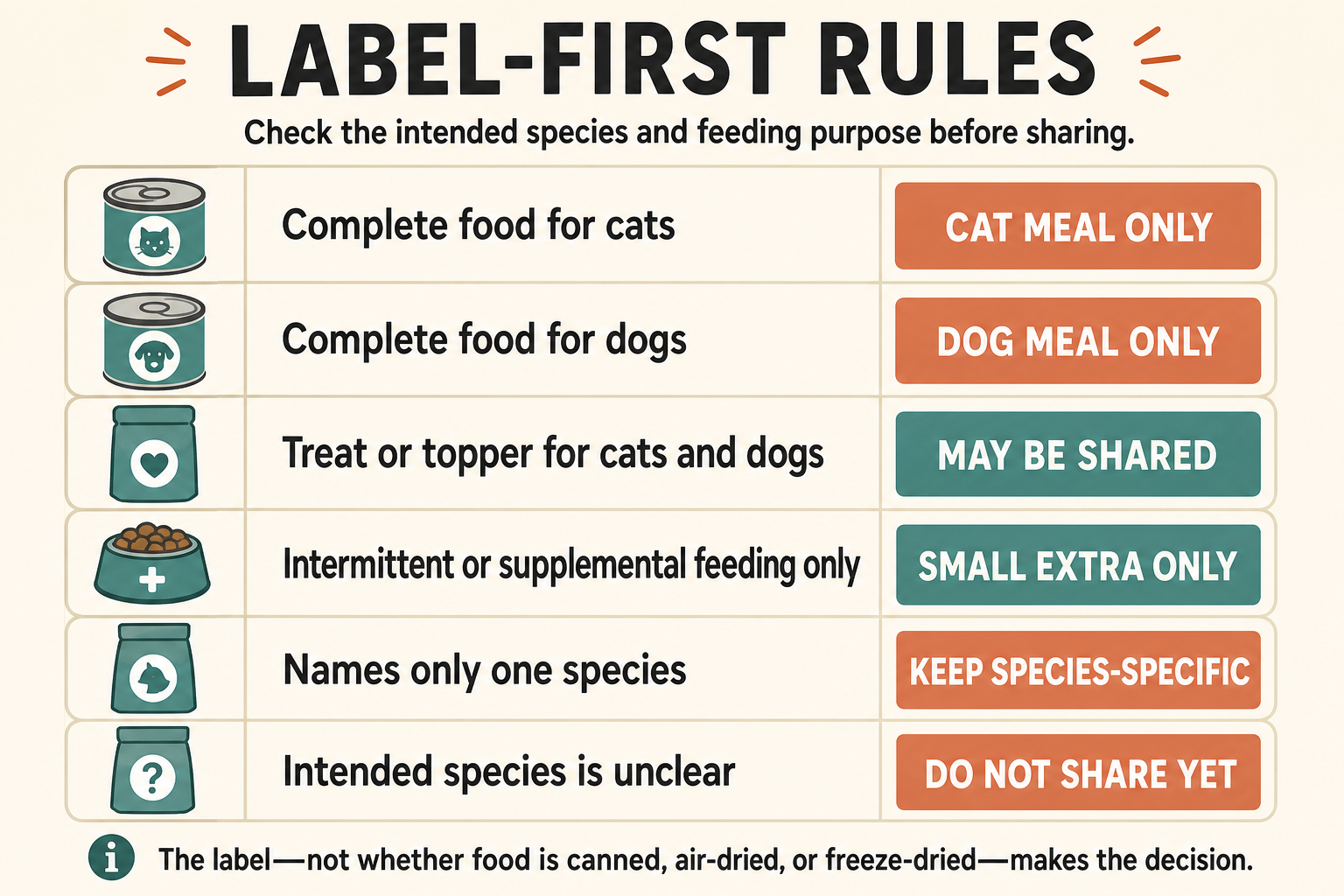
Check the intended species and feeding purpose before sharing. Ingredients, portion size, calories, and each pet's health needs still matter.
Dogs and cats have different nutrient requirements. AAFCO specifically advises selecting food for the pet's species, life stage, and condition. Cats require nutrients such as taurine, preformed vitamin A, and arachidonic acid in feline-appropriate amounts. The Merck Veterinary Manual notes that dog foods may not assure enough of these nutrients for cats.
One stolen bite is different from a feeding routine. A healthy adult cat tasting a little dog food, or a healthy dog licking a cat's bowl, is usually not a nutritional emergency. Repeatedly substituting one species' complete food for the other's can create problems.
Single-ingredient freeze-dried products are often easiest to share
A freeze-dried chicken-breast treat containing only chicken is easier to evaluate than a long recipe with flavorings, binders, supplements, and several protein sources. If the package says it is a treat for both cats and dogs, many healthy adult pets can share it in small portions.
Still check all of the following:
- The label explicitly includes both cats and dogs.
- The one ingredient is suitable for both individual pets.
- Neither pet is allergic to that protein or completing a food-elimination trial.
- The product is a treat, not a complete meal that must provide species-specific nutrition.
- The pieces can be made small and soft enough for safe eating.
- You follow storage, handling, and rehydration directions.
“Single ingredient” does not automatically mean “safe for everyone.” A pet can have an allergy or intolerance to chicken, beef, fish, or another ordinary ingredient. Liver and other organs can be nutrient-dense and should not be given freely. Very hard cubes can be difficult for a cat, small dog, senior pet, or pet with dental disease.
Freeze-drying also does not make raw animal ingredients sterile. If a product is raw, treat it as raw: follow the package directions, wash your hands and bowls, keep it away from young children and immunocompromised people, and avoid letting pets carry pieces onto household surfaces.
Air-dried can be shareable—but read beyond the front
Air-dried products cover several different categories:
- single-ingredient treats;
- jerky-style treats;
- multi-ingredient toppers;
- complete cat diets; and
- complete dog diets.
A plain, single-ingredient air-dried treat labeled for both species may be a practical shared option. A complete air-dried dog food is not a feline meal, even if meat is the first ingredient. Likewise, a rich complete cat recipe is not intended to become a dog's regular food.
Texture matters. Air-dried pieces may be dense, chewy, or hard. Bend or break a piece before offering it. If it cannot be reduced to a safe size without producing sharp, tough edges, choose a different product for the cat.
Be cautious with jerky that contains salt, smoke flavor, glycerin, sweeteners, spices, onion, or garlic. “Air-dried” describes a process; it does not guarantee a short ingredient list or suitability for both species.
Canned wet food is usually not for sharing
Most canned wet foods are complete recipes made for either cats or dogs. Processing with moisture is not the problem. The formula and intended use are.
A canned dog food may look meat-rich but still fail to meet a cat's long-term nutrient needs. A canned cat food may be richer or more calorie-dense than a dog needs. Regularly allowing a dog to finish cat food can contribute to excess calories or digestive upset, while routinely feeding dog food to a cat can displace essential feline nutrition.
There are exceptions. Some canned products are simple toppers—such as chicken in broth—and are labeled for intermittent or supplemental feeding. A product explicitly labeled for both cats and dogs may be shareable as a small extra. Check the complete ingredient list because broths and gravies can add salt, thickeners, or other ingredients that make a seemingly plain product less simple.
Never assume that human canned meat or fish is the same as a pet topper. It may contain excessive sodium, oil, onion, garlic, sauces, or bones. Plain canned pumpkin is another product people sometimes share, but it should be 100% pumpkin rather than sweetened or spiced pie filling, and it should be used only when it fits the pet's diet.
Cats usually need smaller pieces
The serving pictured on a dog-treat bag may be far too large for a cat. Cats often prefer small prey-sized bites and may walk away from a large, tough cube even when they like its smell.
For a cat:
- crumble or cut dried food into small pieces;
- soften or rehydrate it if the label permits;
- supervise the first few servings;
- discard pieces that become sharp or stringy; and
- do not assume the cat will chew a large piece thoroughly.
Small dogs, flat-faced pets, seniors, fast eaters, and animals with missing or painful teeth may need the same adjustments. Stop offering a product if a pet coughs, gags, repeatedly drops it, swallows pieces whole, or struggles to chew.
A five-step sharing check
Before putting a product in a shared treat jar, ask:
- Does the label name both species? If not, keep it for the named pet.
- Is it a treat or a complete food? Shareable items should generally be occasional extras, not species-specific meals.
- Is every ingredient appropriate? Avoid products with onion, garlic, xylitol, or other unsafe ingredients, and account for each pet's allergies.
- Can both pets eat the texture safely? Break it to suit the smaller or less capable chewer.
- Does it fit both health plans? Prescription diets, food trials, pancreatitis history, kidney or urinary disease, diabetes, and weight-loss plans can make an otherwise ordinary treat unsuitable.
If one answer is no or unclear, do not share the product.
Keep shared foods in the “extras” budget
Treats and toppers can dilute a balanced diet when they become too large a part of the day. The FDA's explanation of complete and balanced pet food notes that treats, snacks, and supplements are typically not intended to be a pet's sole diet.
Account for shared pieces alongside every other treat, chew, topper, and table bite. This is especially important for cats and small dogs, for whom one dried cube can represent a meaningful portion of daily calories. Ask your veterinarian for a suitable treat allowance if either pet needs weight management or a therapeutic diet.
Feed shared extras separately so each pet gets the intended portion. A dog can eat a cat's tiny pieces in seconds, while a cat may need quiet time to inspect and nibble. Separate serving also reduces rushing, stealing, and food guarding.
When not to share
Skip shared food when either pet:
- is a kitten or puppy with specific growth needs;
- is pregnant or nursing;
- eats a prescription or veterinary therapeutic diet;
- is in a strict food-elimination trial;
- has a known food allergy or intolerance;
- has pancreatitis, kidney disease, urinary disease, diabetes, or another diet-sensitive condition;
- has swallowing or dental problems; or
- is vomiting, has diarrhea, or has lost interest in food.
In these situations, “non-toxic” is not enough. The product needs to fit the individual medical and nutritional plan.
The practical takeaway
Cats and dogs can sometimes share an occasional product, but they should not routinely share complete meals. Single-ingredient freeze-dried and air-dried treats are often the easiest options to evaluate when the package explicitly identifies both species. Canned wet foods are usually formulated for one species and should stay with that pet, although a simple canned topper labeled for both may be an exception.
Read the intended-species and nutritional-adequacy statements, then check ingredients, texture, portions, and medical needs. Make the cat's serving smaller, and keep every shared item in the treat category—not the meal category.
For more context, read Can Cats and Dogs Eat the Same Treats? and Cat vs. Dog Diets: Why Cats Need Taurine.
FAQ
Can cats and dogs share single-ingredient freeze-dried treats?
Often, yes, when the product is labeled as a treat for both species and the ingredient suits both individual pets. Break the cat's portion into smaller pieces and follow safe-handling directions, especially if the product is raw.
Can cats and dogs share air-dried food?
It depends on the product. A single-ingredient treat labeled for cats and dogs may be shareable. A complete air-dried diet made for one species should not become the other species' meal.
Can cats and dogs share canned wet food?
Usually not as a regular meal. Most canned foods are complete diets formulated for either cats or dogs. A canned topper labeled for both species may be used as a small extra if its ingredients and calories suit both pets.
What if my cat eats a little dog food?
A small accidental taste is usually not an emergency for a healthy cat. Do not make it routine, because dog food may not provide the nutrients a cat needs. Contact your veterinarian if the cat ate a large amount, the food contains a concerning ingredient, or the cat becomes unwell.
This article is for general education and is not a substitute for veterinary advice. Ask your veterinarian before changing the diet of a growing pet or an animal with a medical condition.
Common questions
Can cats and dogs share single-ingredient freeze-dried treats?
Often, if the label identifies the product as suitable for both species, the ingredient is safe for both pets, and each piece is portioned appropriately. Single-ingredient does not override allergies, medical diets, or safe-handling instructions.
Can cats and dogs share air-dried food?
Sometimes. A single-ingredient air-dried treat labeled for both species may be shareable, but many air-dried products are complete diets or multi-ingredient recipes made for only cats or dogs. Check the full label.
Can cats eat canned dog food?
An accidental small taste is usually not an emergency for a healthy cat, but canned dog food should not be a cat's regular meal because it is not formulated to meet feline nutritional requirements.

